I. Product Design Positioning
Available in multiple range specifications from 0.001g analytical balance to 0.01g precision balance, the AJ series targets pharmaceutical laboratories, chemical research, jewelry inspection and small-batch industrial batching. Compared with ordinary digital weighing scales, its layered firmware filtering and full-range linear calibration effectively reduce weighing errors caused by airflow, vibration and temperature drift, delivering consistent repeatability for long-term daily testing.
The overall system architecture is built around three core principles:
- 1. Sensor signal stability
- 2. Operational logic consistency
- 3. Output data expandability
II. Weighing System Structure
1. Sensor Working Principle
The system uses a strain-gauge load cell. Mechanical deformation of the metal structure generates an electrical signal, which is then amplified and processed through digital filtering to produce a stable weight output.
Key control factors include:
- 1. Resistance to micro-vibration interference
- 2. Temperature drift compensation
- 3. Long-term repeatability stability
2. Stability Determination Mechanism
The system uses an internal stability judgment logic to determine when the data is in a “readable state,” preventing inaccurate output caused by vibration or airflow interference.
III. Control System Logic
The AJ electronic balance does not operate through simple button triggering, but through a state-machine architecture.
1. Core Operating States
- 1. Zero state (reference reset)
- 2. Weighing state
- 3. Calibration state
- 4. Function parameter setting state
5. State transitions are controlled by key combinations rather than single-function triggers.
2. Key Operation Logic
The control system uses a dual-level input structure (short press / long press):
- 1. ZERO: baseline reset
- 2. TARE: net weight mode switching
- 3. CAL: calibration entry system
- 4. PCS: counting mode
- 5. UNIT: unit switching & hidden unit system
This design reduces misoperation and improves adaptability in industrial environments.
IV. Calibration System (Calibration Architecture)
The AJ series adopts a dual calibration structure:
1. Single-Point Calibration
Used for basic offset correction. It performs linear shift adjustment of the measurement baseline.
2. Linear Calibration
Uses multi-point loading (stepwise weights) to build a weight-to-signal mapping curve, correcting non-linear deviation across the full range.
This improves:
- 1. Full-range accuracy consistency
- 2. Edge-range measurement stability
- 3. Long-term system reliability
V. Data Output System
The device integrates a dual-channel data output architecture:
- 1. USB digital output
- 2. RS232 serial communication
Output behavior is state-driven:
- 1. Continuous output (real-time streaming)
- 2. Stable-trigger output
- 3. Manual-trigger output
- 4.Batch sequence output
This allows direct integration into automated systems without manual recording.
VI. Firmware Parameter System (Internal Logic Control)
The internal firmware is structured into layered functional modules:
F1 (Display System)
Controls backlight behavior:
- Always on
- Auto mode
- Off
F2 (Sensor Parameters)
Factory-level calibration parameters (pre-set, non-user adjustment in normal use).
F3 (Stability Filtering)
Controls response speed vs. stability balance in weight fluctuation processing.
Baud Rate
Supports multiple communication speeds for system compatibility.
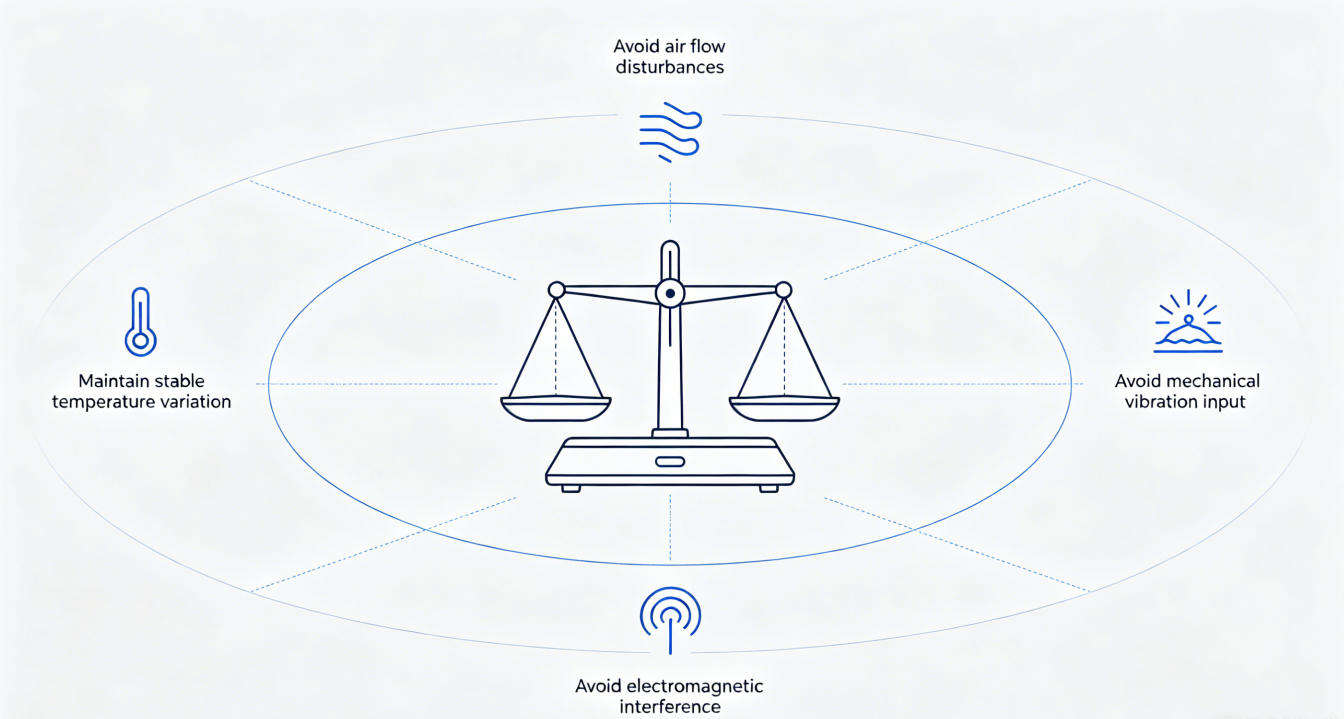
VII. Environmental Requirements (Engineering Constraints)
As a micro-weight measurement system, performance is highly sensitive to environmental conditions:
- 1. Avoid air flow disturbances
- 2. Avoid mechanical vibration input
- 3. Avoid electromagnetic interference
- 4. Maintain stable temperature variation
These conditions directly affect sensor output stability rather than display performance.